

Why the word alone fails
Image models learned the film look from millions of stills and trailers. They know it already. What they cannot do is guess which version of it you mean.
"Cinematic" covers a noir alley, a wheat field and a neon chase equally well, so the model averages them into something polished and anonymous. A frame that reads as film has five describable properties: something is mid-action, the light comes from a source the scene could hold, the camera sits somewhere on purpose, the palette was chosen, and the air is visible. Each is a decision with a name. This guide groups the names by decision and builds one prompt, a ferry deckhand at dawn, one clause at a time.
The order of a prompt
Models weight the start of a prompt more than the end, so say what is happening first and how it is rendered last.
1 Moment Who, doing what, where, when | 2 Frame Shot size, angle, composition | 3 Glass Focal length and focus | 4 Light Source, direction, fill | 5 Color Palette, grade, stock | 6 Air Atmosphere, texture, mood | 7 Format Ratio and parameters |
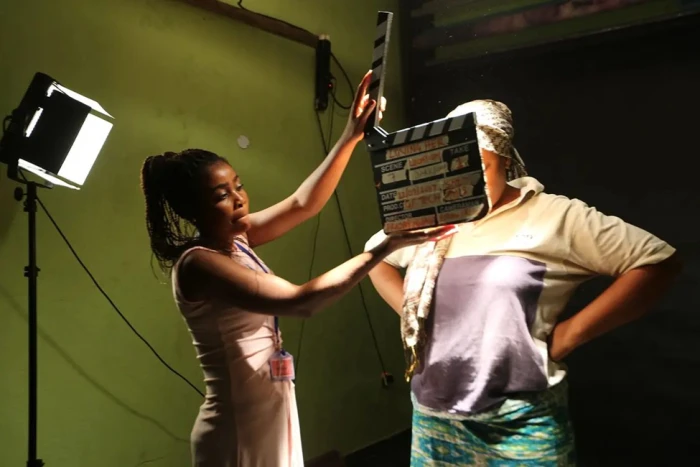
Keep the skeleton and swap the first clause; the same seven slots produce a wedding, a heist or a product shot.
Decision 1: The moment
What is happening in this exact instant, and what happened a second before?
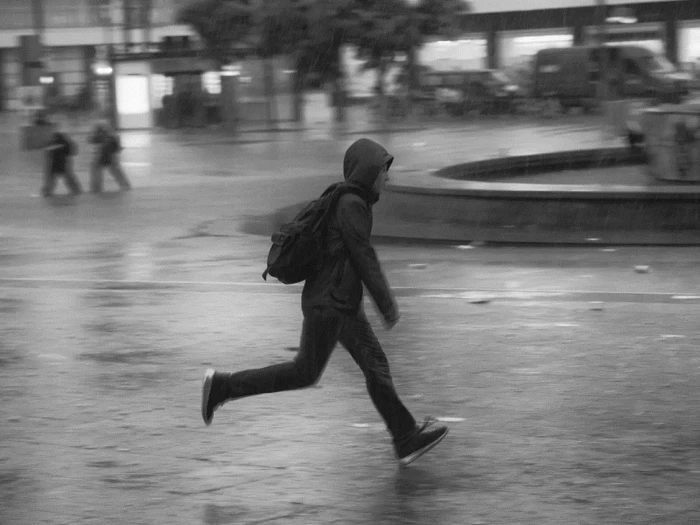
"Standing in a kitchen" is a stock image; "reaching for a ringing phone with a wet hand" is a scene. One subject, one verb, one direction, then a place and a time of day. Time cues suggest the light before you have described it.
| Ingredient | What it supplies | Example |
|---|---|---|
| Action verb | What the body is doing right now. | wiping down the pass, turning toward the door |
| Gaze | A second point of interest in the frame. | eyes on the far end of the platform |
| Place | Specific enough to imply materials. | a tiled subway stairwell, a plywood workshop |
| Time of day | Implies light and color. | first light, late afternoon, two in the morning |
| Era | Locks period detail and, later, the stock. | 1970s Lisbon, a 1990s open-plan office |
What this prevents: no action. A posing subject is a portrait, and the model lights it like one.
Clause 1 of 7 A ferry deckhand coiling wet rope on the bow, glancing up at the fog horn, first light. |
Decision 2: The frame
Shot size sets the deal between subject and world. Angle sets who has the power.
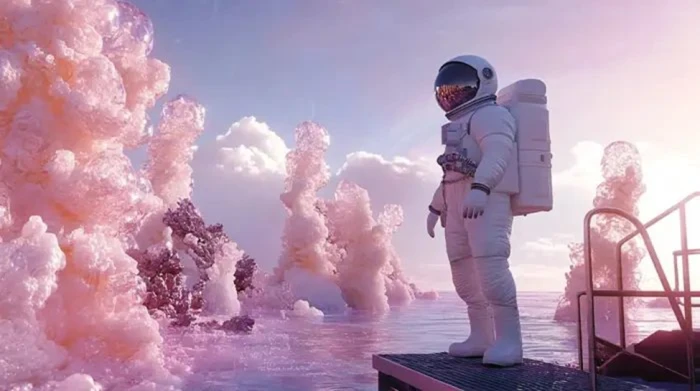
A wide shot with the subject pushed off center. The contrast in scale is the story.
Wide makes people small and places huge; close does the opposite. Looking up makes a subject loom, looking down makes them exposed. Say both, or you get a medium shot at eye level nearly every time. Movement words still help in a still: a frame "from a tracking shot" implies motion.
Shot size
| Term | What it does | Drop-in phrase |
|---|---|---|
| Extreme wide | Location and scale. Subject tiny or missing. | extreme wide shot, a single figure lost in the terrain |
| Wide | Full body plus surroundings. | wide shot, whole figure and the room around them |
| Medium | Waist up. Conversation and action. | medium shot from the waist up |
| Close-up | Face fills the frame. Feeling over place. | close-up, eyes carrying the focus |
| Extreme close-up | One detail. | extreme close-up of a thumb on a lighter wheel |
| Over the shoulder | One subject seen past another. | over the shoulder, foreground shoulder out of focus |
Angle and composition
| Term | What it does | Drop-in phrase |
|---|---|---|
| Eye level | Neutral, documentary. | camera at eye level |
| Low angle | Subject dominates. | low angle, looking up at the figure |
| High angle | Subject diminished or observed. | high angle from a fire escape |
| Top-down | Graphic, map-like. | overhead shot straight down onto the table |
| Dutch angle | Tilted horizon, unease. | dutch angle, horizon tilted about ten degrees |
| Rule of thirds | Subject off center. | subject on the right third, empty space to the left |
| Leading lines | Lines that pull the eye. | rail lines converging on the figure |
| Tracking | Implied motion in a still. | frozen frame from a tracking shot, background streaked |
What this prevents: unspecified framing, which means the centered medium shot: the most anonymous frame in cinema.
Clause 2 of 7 Wide shot from the stern, camera low near the deck, deckhand on the left third, the bow rail running toward him as a leading line. |
Decision 3: The glass
Focal length changes how space feels. Aperture decides how much of it stays sharp.
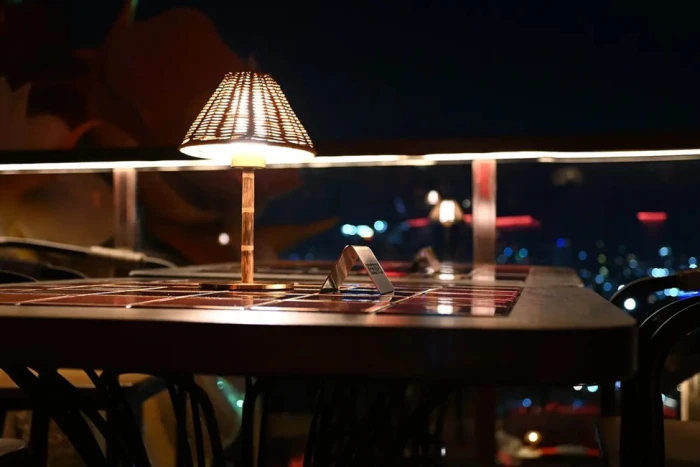
Short lenses stretch distance; long lenses flatten it and melt the background. Then choose shallow focus to isolate one thing or deep focus to let the location count. If one word does the most work here, it is "anamorphic": oval bokeh, horizontal flares and a wide frame at once.
| Term | What it does | Drop-in phrase |
|---|---|---|
| 14mm to 24mm | Vast environments, stretched edges. | 24mm lens, wide sweeping perspective |
| 35mm | Natural and immersive. | 35mm, natural perspective |
| 85mm | Portrait compression, creamy backgrounds. | 85mm portrait lens at f/1.4 |
| 135mm to 200mm | Telephoto stacking, total isolation. | 200mm compression, background stacked flat |
| Shallow depth of field | Only the subject sharp. | shallow depth of field, background dissolving |
| Deep focus | Sharp front to back. | deep focus, sharp from the foreground to the horizon |
| Bokeh | Shape and softness of blurred highlights. | soft round bokeh from distant lamps |
| Anamorphic | Oval bokeh, horizontal flares, wide frame. | anamorphic lens, streaked horizontal flare |
What this prevents: contradiction. "Shallow depth of field" and "everything sharp" cancel out, and both vanish.
Clause 3 of 7 28mm anamorphic lens, deep focus, rope and horizon both sharp. |
Decision 4: The light
If a flat prompt gets one repair, repair the light.
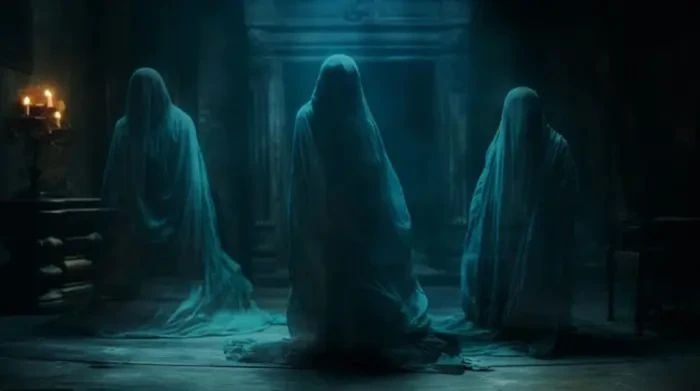
Low key. One cold source from above, warm candle practicals behind, and shadows allowed to stay dark.
Shadowless illumination is why generated images look like catalogue shots. Film light comes from a direction, from a source the scene could hold, and leaves its shadows dark. Name the source, its position, and how much fill, which is usually "minimal".
| Term | What it does | Drop-in phrase |
|---|---|---|
| Motivated light | A source visible or implied in the scene. | lit only by the window on the left |
| Key light | The main source. | single key from camera left at 45 degrees |
| Fill | Lifts shadows. Less fill, more drama. | minimal fill, deep shadow on the far side |
| Rim or back light | Edge of light separating subject from background. | rim light tracing the hair and shoulders |
| Low key | Mostly dark. Noir, thriller. | low key, most of the frame in shadow |
| Chiaroscuro | Hard light against deep dark. | chiaroscuro, hard light carving the figure from black |
| Golden hour | Low warm sun. | golden hour, long shadows, warm backlight |
| Blue hour | Cool sky, lamps glowing. | blue hour, cool ambient, windows glowing |
| Practicals | Lamps, neon, screens, candles in frame. | a neon sign practical throwing magenta on the wet road |
| Volumetric light | Visible beams through haze. | volumetric shafts through dusty air |
What this prevents: light from everywhere. Three sources and no shadow is a catalogue; one source and minimal fill is a film.
Clause 4 of 7 Lit by the pale dawn sky from the right and a single amber deck lamp behind him, minimal fill, the wheelhouse falling into shadow. |
Decision 5: The color
A grade is a ruling on which colors may appear. A stock name delivers that ruling in two words.
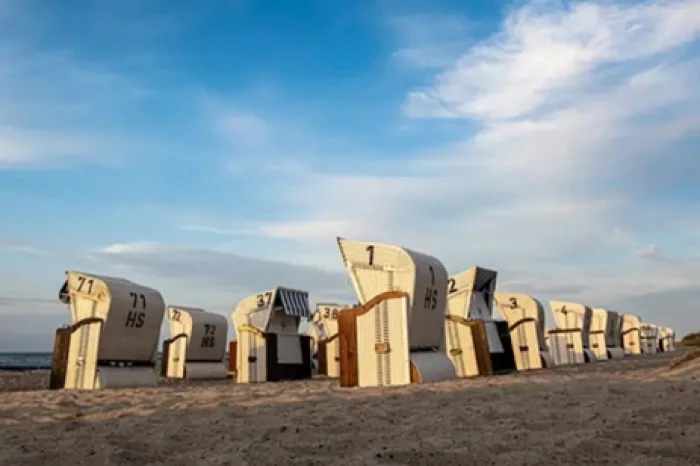 The camera's neutral rendering. | 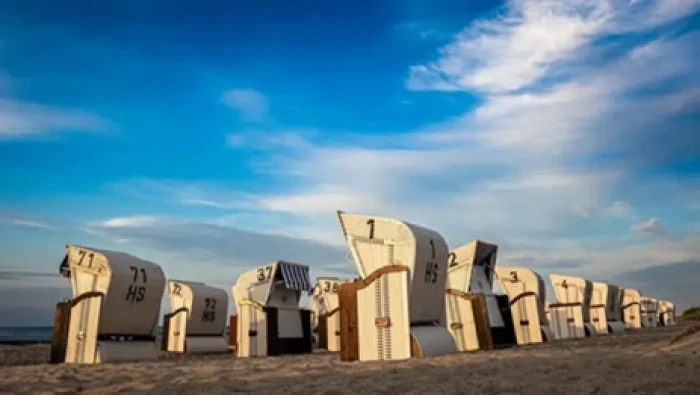 The same frame graded: warmer highlights, cooler shadows, lifted contrast and a widescreen crop. |
Each stock stands for a package of color, contrast and grain the model has seen thousands of times. Hold the palette to two hues, with a third only as a practical accent, and match the stock to the era: a 1940s office on a neon night stock looks wrong even to viewers who cannot say why.
| Term | What it does | Drop-in phrase |
|---|---|---|
| Teal and orange | Cool shadows, warm skin. The blockbuster default. | teal and orange grade |
| Desaturated | Muted, serious. | desaturated, muted earth tones |
| Monochromatic | One hue, many values. | monochromatic amber palette |
| Complementary | Two opposing hues for tension. | magenta and green complementary palette |
| Crushed blacks | Dense, moody shadows. | crushed blacks, heavy contrast |
| Lifted blacks | Faded, nostalgic shadows. | lifted blacks, faded print look |
| Kodak Vision3 500T | Tungsten cinema stock. Warm interiors. | Vision3 500T look |
| Kodak Vision3 250D | Daylight cinema stock. Clean exteriors. | Vision3 250D look |
| Kodak Portra 400 | Gentle skin, pastel warmth. | Portra 400 look |
| CineStill 800T | Night stock, red halation. | CineStill 800T look, red halation around the lights |
| Fujifilm Eterna | Low contrast, cool greens. | Eterna look, restrained contrast |
| Kodak Double-X | Black and white, rich mid tones. | black and white, Double-X look |
| Kodak Ektachrome | Slide film, clean saturation. | Ektachrome look |
What this prevents: "colorful", or more than two hues. Nothing chosen, nothing designed.
Clause 5 of 7 Cold slate blue and amber complementary palette, Fujifilm Eterna look, lifted blacks. |
Decision 6: The air
Atmosphere makes air visible. Texture fights the plastic finish. Mood words steer the rest.
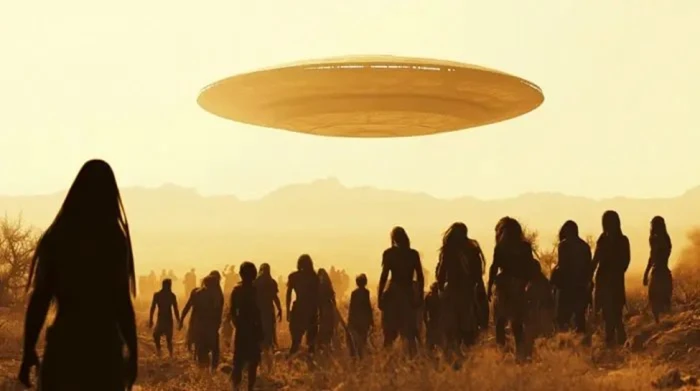
Haze, dust and a low sun behind the crowd. Every figure becomes a shape and the distance softens on its own.
Haze, dust, rain and steam give light a surface to strike, which creates depth. Grain and skin texture push back against default smoothness. One or two mood words describe nothing visible yet tip every small choice the model makes.
| Term | What it does | Drop-in phrase |
|---|---|---|
| Haze or fog | Softens distance, reveals beams. | light haze, distance fading softly |
| Dust motes | Intimacy and stillness. | dust drifting through the beam |
| Rain and wet surfaces | Reflections double every light. | rain-slick street reflecting the signs |
| Smoke and steam | Movement in interiors. | steam rising into the backlight |
| Film grain | Reads as celluloid. | subtle film grain |
| Halation | Glow around highlights. | soft halation around the lamps |
| Skin texture | Stops faces looking waxy. | natural skin texture, visible pores |
| Mood words | One or two emotional anchors. | hushed and expectant, or loud and urgent |
What this prevents: quality-word stacking. "8k, masterpiece" buys polish, the opposite of what you want.
Clause 6 of 7 Sea fog thinning over the water, spray beading on the rope, subtle film grain, natural skin texture, cold and unhurried. |
The wrapper: format and parameters
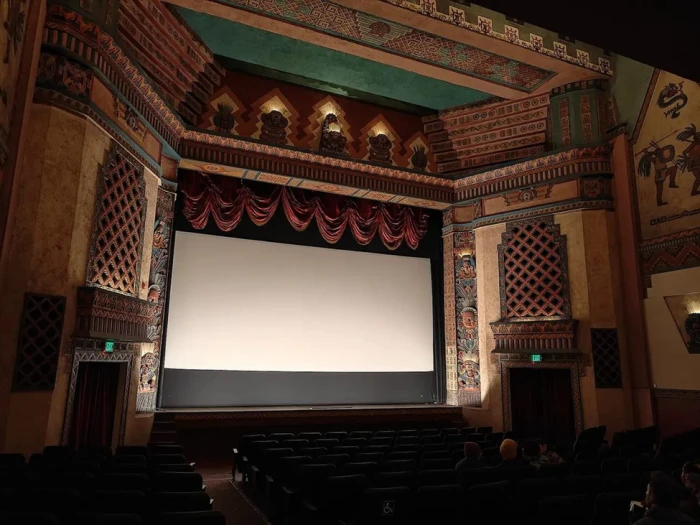
Aspect ratio reshapes composition more than any descriptive word; a square frame fights every widescreen instinct in the prompt. Parameter tools take switches after the text; chat models take a plain sentence.
| Ratio | What it says | Drop-in phrase |
|---|---|---|
| 2.39:1 or 21:9 | The modern film frame. | --ar 21:9, or "widescreen 21:9 frame" |
| 16:9 | Television and web banners. | --ar 16:9, or "16:9 landscape" |
| 1.85:1 | Classic theatrical. | "1.85:1 theatrical frame" |
| 4:3 | Deliberately old-fashioned. | --ar 4:3, or "4:3 academy-style frame" |
Clause 7 of 7 --ar 21:9 --stylize 150 --raw in Midjourney, or "Widescreen 21:9 frame" in a chat model. |
The prompt, assembled
Seven clauses, one prompt.
The full ferry prompt A ferry deckhand coiling wet rope on the bow, glancing up at the fog horn, first light. Wide shot from the stern, camera low near the deck, deckhand on the left third, the bow rail running toward him as a leading line. 28mm anamorphic lens, deep focus, rope and horizon both sharp. Lit by the pale dawn sky from the right and a single amber deck lamp behind him, minimal fill, the wheelhouse falling into shadow. Cold slate blue and amber complementary palette, Fujifilm Eterna look, lifted blacks. Sea fog thinning over the water, spray beading on the rope, subtle film grain, natural skin texture, cold and unhurried. --ar 21:9 --stylize 150 --raw |
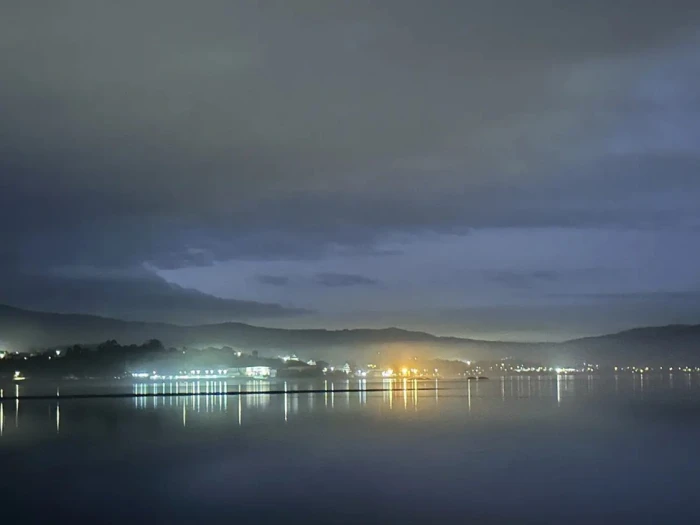
For the night crossing, change "first light" to "blue hour", the dawn sky to "the wheelhouse windows", and Eterna to "Vision3 500T". The framing, lens and structure stay put, which is why a series built on one skeleton looks like one series.
Iterating without guessing
Generate four to eight. Pick the nearest miss. Change one clause and run again
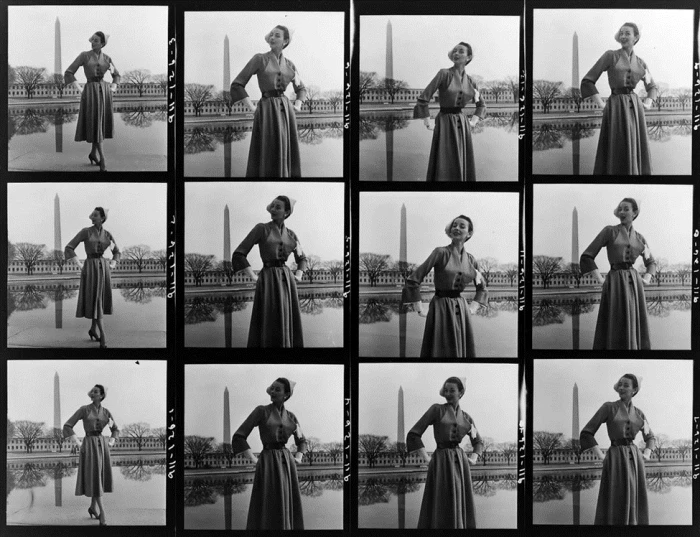
Lens, or light, or grade, never all three; it is the only way to learn what each word does in your tool. When a pass lands, save the seed, the style reference or the reference image. That record is what keeps twenty frames looking like one campaign.
Plain prompt, cinematic prompt
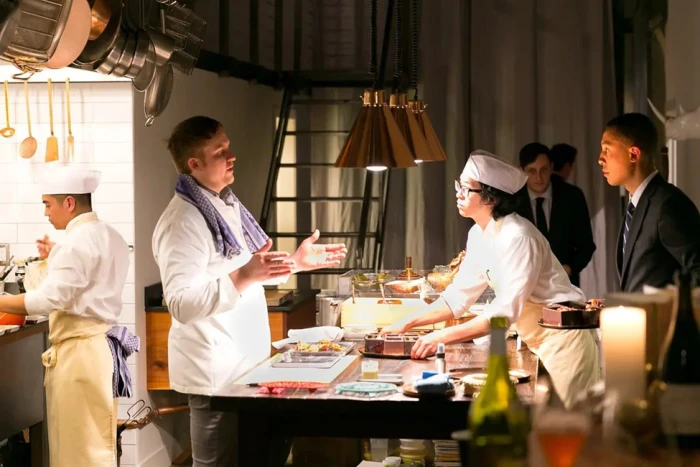
The same decisions written the usual way and the cinematographer's way. Read down the third column to audit a prompt you already have.
| Decision | Plain | Cinematic | What it buys |
|---|---|---|---|
| Subject | A chef in a restaurant | A line cook wiping down the pass after last service, one ticket still clipped above | A moment instead of a job title |
| Framing | Not stated | Medium close-up, camera just below counter height, cook on the right third | Unstated framing means a centered medium shot |
| Lens | Not stated | 85mm at f/1.8 | Compression and blur |
| Light | Dramatic lighting | Lit only by the heat lamps over the pass, minimal fill | Believable shadow, which is where mood lives |
| Color | Vibrant | Amber and steel-blue palette, Vision3 500T look | Two hues and one stock name read as designed |
| Atmosphere | Not stated | Steam off the flat top, faint grease haze | Gives the light a surface |
| Texture | 8k ultra HD | Natural skin texture, subtle grain | Realism instead of polish |
| Ratio | Default square | 2.39:1 | Recomposes the whole frame |
| Iteration | Regenerate until lucky | One clause per pass, seed saved | You learn what each word does |
Ten templates to swap into
Each template follows the seven-clause skeleton and targets a different genre. Copy one, replace the moment and the setting, keep the technical clauses. The line under each name tells you which clause carries the look, so you know what not to delete.
Neon rain close-up
Wet surfaces double the practicals, and the night stock's halation sells the darkness.
Template 1 Close-up of a delivery rider sheltering under a noodle-shop awning, helmet under one arm, rain, night. 85mm at f/1.4, shallow depth of field. Lit by a magenta sign practical on the left and a cyan drinks-cooler glow on the right, nothing else. Magenta and cyan palette, CineStill 800T look, red halation. Rain beading on the visor, wet pavement bokeh, subtle grain, tired and calm. 2.39:1 |
Desert scale
A tiny figure, a low sun and airborne dust make anyone look mythic.
Template 2 Extreme wide shot of two figures leading a camel across a white salt flat toward a distant dust storm, late afternoon. 24mm, deep focus, horizon on the lower third. Low sun behind them, long shadows across the salt, rim light on the blowing dust. Bleached gold and deep violet palette, Vision3 250D look. Dust catching the light, fine grain, immense and silent. 21:9 |
Noir interior
One hard source through slats and a black-and-white stock tell the whole story.
Template 3 Medium shot of a switchboard operator listening in on a call, 1940s exchange room, night. 50mm, moderate depth of field. Single hard key through venetian blinds striping the desk and her face, no fill, cigarette smoke drifting in the beam. Black and white, Double-X look, deep blacks and silver highlights. Low key, chiaroscuro, guarded and still. 1.85:1 |
Product macro
A motivated backlight and something moving in it give a static object depth.
Template 4 Extreme close-up of a fountain pen nib touching cream paper, ink blooming into the fibers, morning. 100mm macro at f/2.8, focus on the tip of the nib. Backlit by a low window behind the desk, soft reflected fill from the page. Warm monochromatic ivory and brass palette, Portra 400 look. Paper fiber texture, subtle grain, quiet and exact. 16:9 |
Science fiction corridor
Converging lines and volumetric beams build depth in a hard, clean space.
Template 5 Wide shot of a technician sealing a hatch at the far end of a long cargo bay, strip lights waking one by one ahead of her. 24mm anamorphic, deep focus, the bay's lines converging on the figure. Cool white ceiling strips as key, orange floor practicals every few meters, haze revealing the beams. Teal and orange grade, Eterna look, lifted blacks. Horizontal flares, fine grain, methodical and tense. 2.39:1 |
Backlit forest
Sun behind the trees produces the light shafts that define this look.
Template 6 Wide shot of a dog bounding through tall grass toward camera, late summer evening. 35mm at f/2.8, dog sharp, far trees softening. Sun directly behind, rim light on the fur, long shadows across the grass, flare at the top of frame. Warm gold and soft green palette, Portra 800 look. Pollen drifting in the light, thin haze, subtle grain, elated and nostalgic. 21:9 |
Underwater suspension
Overhead caustics and darkness below are a natural low-key setup.
Template 7 Medium shot of a synchronized swimmer suspended below the surface, arms out, looking up. 20mm, deep focus, swimmer on the left third with empty water above. Sunlight from directly overhead breaking into caustic patterns, the figure half silhouetted, black below. Deep teal monochromatic palette, desaturated, crushed blacks. Suspended particles in the light, subtle grain, weightless and calm. 2.39:1 |
Motion frame
Tracking-shot language and background blur imply speed in a still.
Template 8 Low-angle tracking shot beside a cyclist descending a wet mountain switchback at dusk. 35mm, rider sharp, background streaked with motion blur. Blue-hour sky as key, a single following headlight raking the wet tarmac. Steel blue and amber grade, Vision3 500T look. Spray off the tires, mist in the valley below, subtle grain, fast and controlled. 21:9 |
Candlelit period piece
In-frame flames and a painterly reference lock the era and the light together.
Template 9 Two shot of a cartographer and an apprentice bent over a half-drawn map, seventeenth-century study, night. 50mm at f/2, both faces sharp, the shelves behind softening. Lit only by two candles on the table, warm flicker, deep shadow beyond the desk. Amber and umber monochromatic palette, chiaroscuro in the manner of the Dutch masters, lifted blacks. Candle smoke, subtle grain, absorbed and secretive. 1.85:1 |
Overhead still life
A top-down angle turns a workbench into a graphic composition.
Template 10 Top-down shot of a workbench with a half-assembled watch movement, a loupe, tweezers and a cold cup of tea, morning. 35mm, deep focus, the bench filling the frame edge to edge. Hard sun from a window on the left throwing long sharp shadows across the wood, no fill. Cream and oxblood palette, Ektachrome look, slightly desaturated. Brass dust on the wood, worn bench texture, subtle grain, patient and precise. 4:3 |
How each tool reads the vocabulary
The words work everywhere. What changes is how literally each engine follows them and how you keep a look steady across a series.
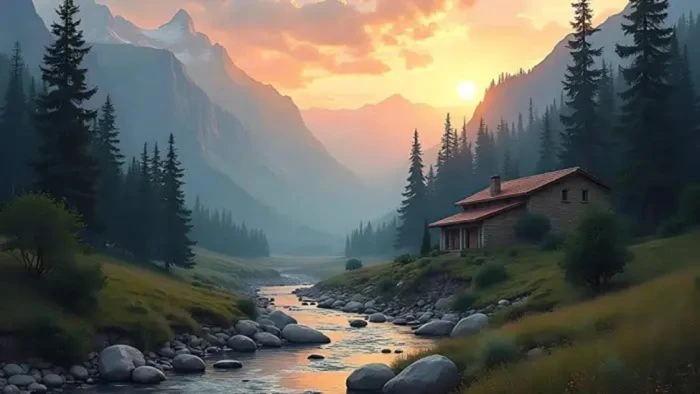
The same golden-hour vocabulary rendered by an open-weights model.
Midjourney Strongest default film look, easiest series consistency --ar sets the frame, --stylize sets how much of its own taste it adds, --raw turns that down for a literal read. --sref copies a grade from an image or code; --oref keeps a character steady across shots. Watch for: the house style overriding subtle light words unless you use --raw. |
ChatGPT image generation Best for talking your way to the frame Everything in prose, no switches. It keeps context, so one message per pass edits the same scene instead of starting over. Text in frame renders reliably. Watch for: a bias toward clean output that softens heavy grain. Ask twice. |
Gemini image models Best for photoreal materials and light physics Terms like rim light, practical, caustics and halation land accurately, and reference images anchor grade and lighting. A free tier lets you test before paying. Watch for: painterly, heavily graded looks, which are less its strength. |
FLUX Best for control, pipelines and self-hosting Literal by default. Exact width and height, multiple references, held color values, and open variants you can train on your own frames for a house look. Watch for: setup effort, and hosted variants that differ in quality and cost. |
Adobe Firefly Best for commercially safe client work Licensed training data and indemnification. Style and structure references, lighting and camera menus, finishing in Photoshop. Watch for: a lower ceiling on gritty looks and stricter filtering of stock and artist names. |
Pick by job: Midjourney for the look, ChatGPT for conversation, Gemini for realism, FLUX for pipelines, Firefly for legal cover. Version names and pricing move quickly, so check each vendor's documentation.
Pre-flight checklist
Any answer of "not stated" is the clause you still need to write.
- Is the subject doing one specific thing, right now, in a named place and time?
- Are both the shot size and the camera angle named?
- Is a focal length named, and have I decided what stays sharp?
- Is there one motivated light source with a direction, and have I decided the fill?
- Is the palette held to two hues, with a stock or grade named?
- Is there something in the air, plus one texture word?
- Is the aspect ratio set, with the tool's parameters added?
- If this is a second pass, have I changed only one clause since the last one?
None of this is a bag of magic words. It is the habit of making a cinematographer's decisions in a cinematographer's order and saying them out loud. Build the habit and every engine in the list will hand back frames that look like they were lifted from a film.

Discussion
No comments yet. Be the first to share your thoughts!